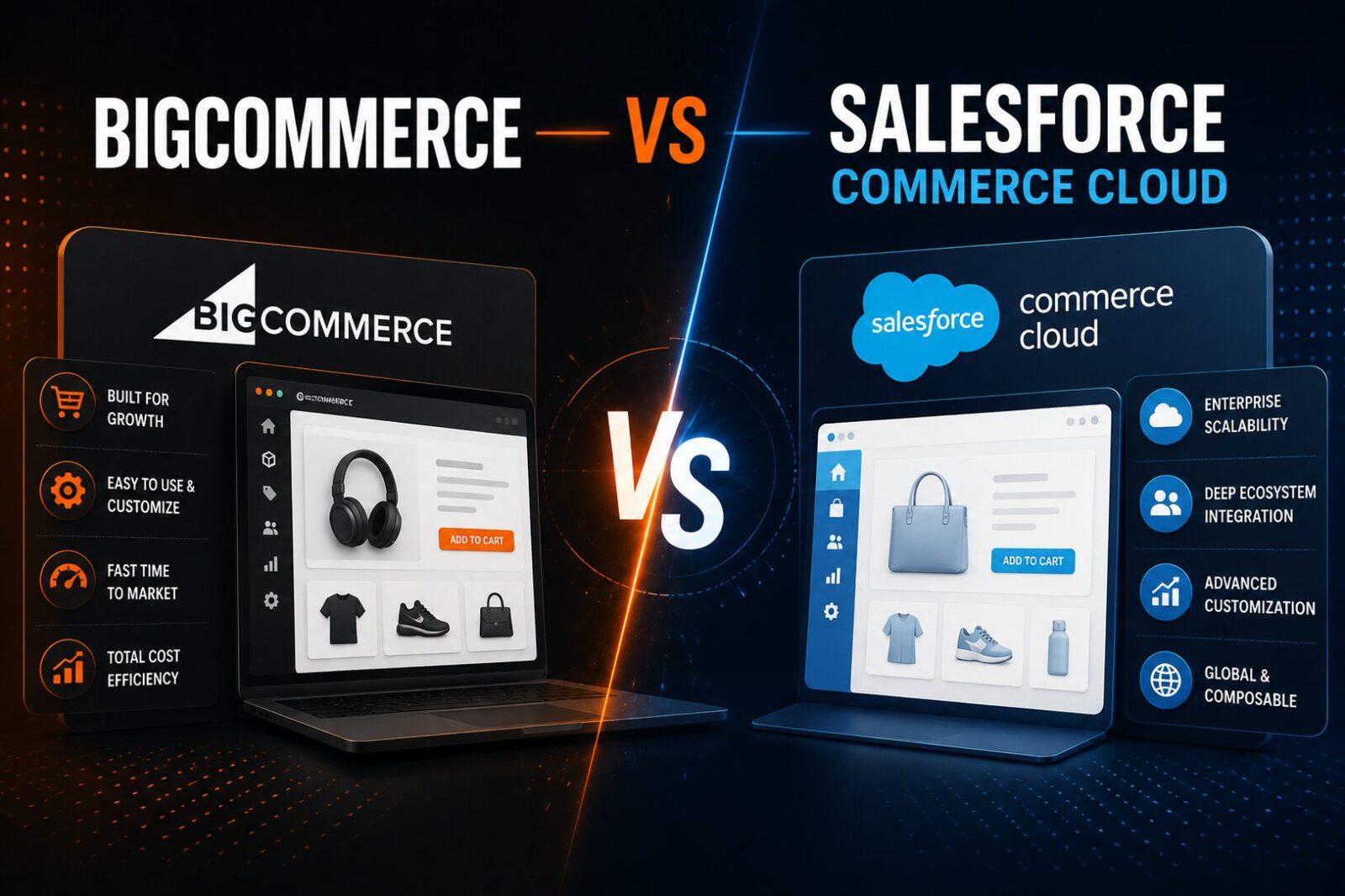
BigCommerce vs Salesforce Commerce Cloud: Which Enterprise Commerce Platform Fits Your Business?
Affiliate Disclosure: We review products independently. When you buy through our links, we may earn a commission or a compound recurring commission at zero extra cost to you. Read our editorial policy.
BigCommerce vs. Salesforce Commerce Cloud is a comparison between two different approaches to enterprise ecommerce. BigCommerce combines a hosted commerce platform with optional B2B capabilities, while Salesforce Commerce connects ecommerce more closely with the broader Salesforce business ecosystem. The right choice depends on your sales model, existing technology stack, B2B requirements, implementation resources, and total cost of ownership.
For businesses that need a flexible ecommerce platform without committing to a Salesforce-centered architecture, BigCommerce is worth evaluating first. For enterprises that already rely heavily on Salesforce for customer relationships, sales, service, and business data, Salesforce Commerce may offer a stronger strategic fit.
Neither platform is automatically the better choice for every enterprise. This comparison explains where each fits, what buyers should evaluate, and how to make the decision without relying on feature lists alone.
Updated: October 2026. Pricing and product capabilities can vary by edition, contract, configuration, and implementation scope. Confirm commercial terms and requirements with each vendor before making a purchasing decision.
BigCommerce vs. Salesforce Commerce Cloud at a Glance
| Evaluation factor | BigCommerce | Salesforce Commerce |
|---|---|---|
| Core approach | Hosted ecommerce platform with APIs and extensibility | Enterprise commerce within the Salesforce product ecosystem |
| Best-fit business | Businesses seeking flexible commerce with manageable platform operations | Enterprises seeking commerce closely connected to Salesforce |
| B2B commerce | B2B Edition provides company accounts, quoting, buyer roles, and self-service tools | B2B Commerce supports business-specific buying experiences on the Salesforce platform |
| Customer data and CRM | Integrates with external CRM and business systems | Particularly attractive when Salesforce is already central to customer operations |
| Storefront flexibility | Supports traditional and headless approaches | Supports configurable enterprise commerce experiences; architecture depends on the product and implementation |
| Integrations | APIs, apps, and integration partners | Salesforce ecosystem, APIs, and integration partners |
| Pricing | Subscription-based plans; advanced B2B capabilities may require additional commercial arrangements | Quote-based pricing for relevant enterprise commerce editions |
| Implementation | Scope depends on integrations, storefront customization, and migration complexity | Scope depends on Salesforce architecture, data, integrations, customization, and business processes |
| Main consideration | Verify plan limits, B2B requirements, and integration costs | Evaluate licensing, implementation, specialist resources, and ongoing administration |
BigCommerce documents its B2B Edition features, including company account management, buyer roles, quotes, shared shopping lists, and invoice management. Salesforce offers separate commerce solutions for B2B and B2C requirements, so buyers should compare the relevant Salesforce product rather than treating every Commerce offering as identical. BigCommerce B2B Edition documentation · Salesforce Commerce pricing and editions.
What Is BigCommerce?
BigCommerce is a hosted ecommerce platform that gives businesses a managed foundation for building and operating online stores. Businesses can configure storefronts, manage products and orders, connect external systems, and extend the platform through apps, APIs, and custom development.
Its appeal is the combination of managed infrastructure and flexibility. Companies can build a conventional storefront or adopt a more customized architecture without having to build the entire commerce platform from scratch.
For B2B sellers, BigCommerce offers B2B Edition, which adds tools for business purchasing and account management. These include company accounts, buyer permissions, sales quotes, shared shopping lists, quick ordering, invoice management, and customer-specific workflows. Availability and configuration should be confirmed against the merchant’s proposed plan and contract. Source: BigCommerce B2B Edition.
Where BigCommerce fits best
BigCommerce is worth shortlisting when a business:
- Wants a managed ecommerce platform rather than a fully self-managed commerce stack.
- Needs B2B purchasing capabilities such as company accounts, negotiated quotes, and buyer permissions.
- Uses a separate CRM, ERP, inventory, or order management system and wants to integrate those systems with its storefront.
- Needs multiple storefronts, specialized buying experiences, or a headless architecture.
- Wants to evaluate commerce independently of a broader enterprise software ecosystem.
BigCommerce is not a no-development solution for every enterprise. Complex ERP integrations, custom pricing rules, specialized checkout requirements, and sophisticated catalog structures can still require implementation partners and ongoing technical support.
What Is Salesforce Commerce Cloud?
Salesforce Commerce is an enterprise commerce offering within the Salesforce ecosystem. The relevant solution depends on whether a company sells primarily to businesses, consumers, or both, and which Salesforce products and services it already uses.
Salesforce B2B Commerce supports business purchasing experiences on the Salesforce platform. Other Salesforce commerce offerings address consumer commerce and related omnichannel requirements. Buyers should confirm the specific product, edition, and architecture proposed by Salesforce before comparing it with BigCommerce.
The platform’s strategic appeal is its relationship with the wider Salesforce environment. For a company already using Salesforce for sales, customer service, marketing, or customer data, connecting commerce with those processes may reduce fragmentation and improve coordination across teams.
That advantage is not automatic. Integration design, data quality, licensing, and implementation choices determine how much value the business realizes.
Where Salesforce Commerce fits best
Salesforce Commerce is worth shortlisting when a business:
- Already uses Salesforce extensively for customer-facing operations.
- Needs commerce to work closely with Salesforce CRM data and business processes.
- Has complex B2B relationships, account structures, or sales-assisted purchasing journeys.
- Needs coordinated commerce, service, and order-related workflows across enterprise systems.
- Has the budget, internal ownership, and implementation resources for a Salesforce-centered commerce project.
Salesforce Commerce is not necessarily the right choice simply because a company is large. An enterprise that does not rely on Salesforce may be paying for ecosystem capabilities it does not fully use.
1. B2B Commerce: Which Platform Offers the Better Fit?
B2B ecommerce can require substantially more than a product catalog and checkout. Business buyers may need customer-specific pricing, company accounts, approval workflows, purchase orders, negotiated quotes, invoice access, and the ability to reorder products in bulk.
Both platforms can support B2B commerce, but buyers should assess the exact workflows they need rather than comparing broad feature labels.
BigCommerce B2B Edition
BigCommerce B2B Edition includes tools designed around company purchasing and account management. Depending on configuration, these can support:
- Company accounts and account hierarchies.
- Buyer roles and permissions.
- Sales-assisted quoting and negotiated offers.
- Shared shopping lists and approval-oriented purchasing.
- Quick ordering using SKUs.
- Invoice history and payment-related workflows.
- Buyer self-service through the B2B portal.
These capabilities can reduce manual interactions between sales teams and repeat business customers. However, buyers should confirm which features are included, what requires configuration, and whether integrations are needed for their specific pricing or approval rules. Source: BigCommerce B2B Edition documentation.
Salesforce B2B Commerce
Salesforce B2B Commerce is relevant for companies that want business purchasing to operate within the Salesforce platform. Its suitability depends on the selected edition, implementation, data model, and integrations.
For an organization whose sales team already manages customer accounts and relationships in Salesforce, commerce may fit naturally into existing business processes. That can be valuable when sales representatives, account managers, and service teams need a coordinated view of customer activity.
However, buyers should validate their requirements through a detailed demonstration. Ask the vendor to show how the proposed configuration handles customer-specific catalogs, contract pricing, buyer permissions, approvals, quoting, ERP synchronization, and repeat orders.
B2B verdict
Choose based on the complexity of the buying process and the systems already in place.
Shortlist BigCommerce when its B2B Edition and integration options cover the required workflows without unnecessary platform complexity.
Shortlist Salesforce Commerce when the existing Salesforce environment is central to customer relationships and the business expects meaningful operational value from keeping commerce closely connected to it.
Neither platform should be selected on the assumption that every advanced B2B workflow is available out of the box.
2. Integrations, APIs, and Architecture
An ecommerce platform rarely operates in isolation. It may need to exchange data with an ERP, CRM, product information management system, warehouse management system, payment provider, tax service, and analytics tools.
The key question is not simply how many integrations a platform supports. It is how reliably the systems exchange data and how much work is required to maintain those connections.
BigCommerce integrations
BigCommerce offers APIs and integration options that allow businesses to connect their storefronts with external systems. This can suit companies that want to retain existing business applications rather than move their operations into one software ecosystem.
The trade-off is that the business remains responsible for integration design and monitoring. Depending on the architecture, data synchronization, error handling, and custom business logic may require middleware or developer support.
Salesforce Commerce integrations
Salesforce Commerce can be attractive when Salesforce is already the central system for customer relationships and related workflows. It can help organizations align commerce with their existing Salesforce applications, subject to the selected products and integration design.
However, being part of the same ecosystem does not eliminate implementation work. ERP connectivity, product data, inventory synchronization, payment processing, and custom workflows still need to be planned and tested.
Integration verdict
BigCommerce may be the better fit for a business that wants to connect a flexible storefront to an established collection of external systems.
Salesforce Commerce may be the better fit for an organization that wants commerce closely coordinated with its existing Salesforce environment.
Before signing a contract, ask both vendors to demonstrate the highest-risk integrations using realistic data and business scenarios.
3. Customization and Storefront Flexibility
Enterprise buyers often need to balance a distinctive customer experience with long-term maintainability.
BigCommerce supports configurable storefronts and more customized approaches, including headless implementations. This can give development teams flexibility over the customer-facing experience, but custom work can increase implementation and maintenance requirements.
Salesforce Commerce also supports enterprise storefront experiences and customization. The amount of development required depends on the selected product, architecture, design requirements, and integration scope.
The comparison should therefore focus on the specific experience the business wants to deliver, rather than assuming that one platform is universally more customizable.
Evaluate the following:
- Can the team implement the required product discovery and navigation experience?
- Can pricing, promotions, and account-specific experiences follow the required business rules?
- Can developers make changes without creating excessive long-term maintenance?
- Does the platform support the required storefront performance and accessibility standards?
- Can the business support the chosen architecture with its internal team or implementation partner?
A highly customized storefront is useful only if the organization can afford to maintain it.
4. Pricing and Total Cost of Ownership
There is no reliable universal price comparison between BigCommerce and Salesforce Commerce without knowing the products, contract terms, and implementation scope involved.
BigCommerce publishes pricing for its platform plans, while B2B Edition has its own commercial requirements. Salesforce lists relevant enterprise commerce offerings as contact-for-pricing products. A meaningful comparison therefore requires written, scope-matched proposals from both vendors. BigCommerce pricing · Salesforce Commerce pricing.
The subscription or license fee is only one part of the total cost.
| Cost category | What to include in the estimate |
|---|---|
| Platform subscription or license | Required edition, contract term, usage limits, and renewal terms |
| B2B capabilities | Additional modules, portals, or functionality required for business purchasing |
| Implementation | Discovery, design, development, configuration, and project management |
| Integrations | ERP, CRM, inventory, payment, tax, shipping, and middleware connections |
| Data migration | Product catalogs, customer accounts, pricing, order history, and content |
| Ongoing operations | Hosting-related services where applicable, monitoring, support, and administration |
| Development | Internal engineers, contractors, implementation partners, and future enhancements |
| Risk and contingency | Integration complexity, data cleanup, scope changes, and delayed launch costs |
How to compare the real cost
Ask both vendors to provide a three-year cost model using the same assumptions:
- The number of storefronts and markets.
- Annual order volume and revenue.
- The number of products, customer accounts, and business buyers.
- Required B2B workflows and customizations.
- Existing systems that must be integrated.
- Internal staffing and external implementation costs.
- Expected support, maintenance, and future development.
Then separate mandatory costs from optional features and one-time implementation expenses from recurring expenses.
Do not compare a basic BigCommerce subscription with a fully implemented Salesforce Commerce proposal. That would not be an equivalent comparison.
5. Implementation Complexity and Ongoing Maintenance
A platform’s suitability depends partly on whether the business can implement and operate it successfully.
A relatively straightforward BigCommerce deployment may require less coordination than a heavily customized enterprise implementation. However, complex integrations, multiple storefronts, or advanced B2B workflows can significantly increase the effort.
Salesforce Commerce implementation complexity depends on the existing Salesforce environment, data structure, business processes, and selected commerce solution. Organizations with established Salesforce expertise may have an advantage, while businesses without that expertise may need additional specialist support.
Neither platform guarantees a faster launch. The project scope, quality of existing data, availability of decision-makers, and readiness of connected systems are often decisive.
Before choosing, request an implementation plan that identifies:
- Project phases and milestones.
- Required business and technical resources.
- Data migration and validation responsibilities.
- Integration dependencies.
- Testing and acceptance criteria.
- Training and operational handover.
- Post-launch support and ownership.
Treat a vendor’s estimated launch date as a planning assumption until the scope and dependencies have been documented.
6. Security, Reliability, and Governance
Security and reliability should be evaluated against the business’s own requirements rather than broad claims about either platform.
Review access controls, user permissions, data handling, audit requirements, backup and recovery arrangements, incident response, and any relevant contractual commitments. Also establish how responsibility is divided between the platform provider, implementation partner, and customer.
For B2B commerce, pay particular attention to whether buyers can access only the accounts, pricing, catalogs, and orders they are authorized to see. For integrated environments, assess how changes in customer or product data propagate between systems and how failures are detected.
Ask both vendors to provide documentation for the security, availability, compliance, and support commitments that apply to the proposed products and contract.
7. Which Platform Should You Choose?
The following scenarios provide a practical starting point. They are decision guidelines, not a substitute for requirements validation.
| Business scenario | Platform to shortlist first | Why |
|---|---|---|
| Midmarket business seeking managed ecommerce with B2B options | BigCommerce | Combines hosted commerce with dedicated B2B capabilities |
| Company with an established ERP and a separate CRM | BigCommerce | Can suit a business that wants to retain its existing systems |
| Enterprise with extensive Salesforce-based customer operations | Salesforce Commerce | Offers a closer fit with the existing Salesforce environment |
| Business with complex account-based purchasing | Both | Validate the exact pricing, approval, quoting, and account workflows |
| Company with limited internal technical resources | Neither by default | Compare implementation and ongoing support requirements before choosing |
| Organization planning a major commerce transformation | Both | Evaluate architecture, migration risk, total cost, and long-term operating model |
Choose BigCommerce if:
- You want a managed ecommerce foundation with room to extend it.
- Its B2B Edition covers your required business purchasing workflows.
- Your business uses multiple systems and does not need commerce to be centered on Salesforce.
- The proposed solution meets your requirements at a competitive three-year total cost.
- Your team can support the integrations and customizations in the proposed architecture.
Choose Salesforce Commerce if:
- Salesforce is already central to your customer-facing business operations.
- Commerce needs to work closely with existing Salesforce data and workflows.
- The selected Salesforce solution supports your B2B or B2C requirements.
- Your organization has the budget, technical ownership, and implementation support to operate the solution.
- The value of ecosystem alignment justifies the full implementation and operating cost.
Consider alternatives or a deeper architecture review if:
Neither proposal satisfies your requirements without extensive customization, costly workarounds, or unacceptable operational complexity. In that case, compare the actual requirements against other commerce platforms before committing to a migration.
Questions to Ask Before Signing a Contract
Use these questions in vendor demonstrations and commercial discussions:
- Which exact product edition and modules are included in the proposal?
- Can you demonstrate our required B2B pricing, account, quoting, and approval workflows?
- Which capabilities require additional licenses, third-party applications, or custom development?
- How will the platform integrate with our ERP, inventory, CRM, and payment systems?
- What are the implementation milestones, dependencies, and acceptance criteria?
- What will the platform and implementation cost over three years?
- What technical resources will we need after launch?
- How will we test security, data accuracy, performance, and recovery procedures?
- What happens if our transaction volume, product catalog, or number of storefronts grows?
- Which contractual terms govern support, service availability, renewals, and future price changes?
Written answers make the comparison more useful than a general product demonstration.
Frequently Asked Questions
Is BigCommerce better than Salesforce Commerce Cloud?
Not universally. BigCommerce may suit businesses seeking a managed commerce platform with flexible integrations and B2B options. Salesforce Commerce may be a stronger fit for enterprises that already depend on Salesforce for customer relationships and related operations.
Is Salesforce Commerce Cloud only for B2B businesses?
No. Salesforce offers commerce products for both B2B and B2C use cases. Buyers should identify the relevant product and edition before evaluating capabilities, pricing, or implementation requirements.
Does BigCommerce support B2B ecommerce?
Yes. BigCommerce B2B Edition includes capabilities such as company account management, buyer roles, quoting, shared shopping lists, quick ordering, and invoice-related workflows. Availability and configuration should be confirmed with BigCommerce for the proposed solution.
Which platform is cheaper?
There is no universal answer. BigCommerce’s published plan pricing can help establish a starting point, but B2B capabilities, implementation, integrations, and operating costs must be included. Salesforce Commerce pricing is quote-based for relevant enterprise offerings. Compare written proposals using the same scope and a three-year cost model.
Which platform is easier to implement?
Implementation effort depends on the requirements, existing systems, data quality, and available technical expertise. A simpler BigCommerce deployment may be relatively straightforward, while either platform can become complex when extensive customization and integrations are required.
Can both platforms integrate with an ERP?
Both can be evaluated for ERP integration. The right design depends on the ERP, data synchronization requirements, available connectors or APIs, and the business processes involved. Request a demonstration of the actual integration scenario rather than relying on a generic compatibility statement.
What should a business prioritize when choosing an enterprise ecommerce platform?
Start with the required buying experience, integration architecture, security and governance requirements, and three-year total cost of ownership. Then assess implementation risk and the internal resources needed to maintain the solution.
Final Verdict
BigCommerce and Salesforce Commerce serve overlapping but distinct enterprise needs. BigCommerce is worth prioritizing when a business wants a managed commerce platform with flexible integrations and B2B capabilities that fit its requirements. Salesforce Commerce deserves closer consideration when the organization already relies on Salesforce and expects commerce to benefit from that existing environment.
The strongest decision is not the platform with the longest feature list. It is the one that supports the required customer experience, integrates reliably with business systems, fits the organization’s operating capabilities, and delivers acceptable total cost over time.
Before committing, obtain a detailed proposal from each vendor, validate the highest-risk workflows, and compare the same three-year scope. That process will produce a more defensible choice than relying on headline prices or generalized claims about enterprise readiness.
Sources and Further Reading
- BigCommerce B2B Edition
- BigCommerce pricing
- Salesforce Commerce pricing and editions
- Salesforce Commerce documentation
Editorial note: Product capabilities and commercial terms may change. Verify the relevant edition, implementation scope, and contract details directly with each vendor before purchasing.