Best Data Enrichment Tools for B2B Agencies: Outbound Tech Stack Compared
Affiliate Disclosure: We review products independently. When you buy through our links, we may earn a commission or a compound recurring commission at zero extra cost to you. Read our editorial policy.
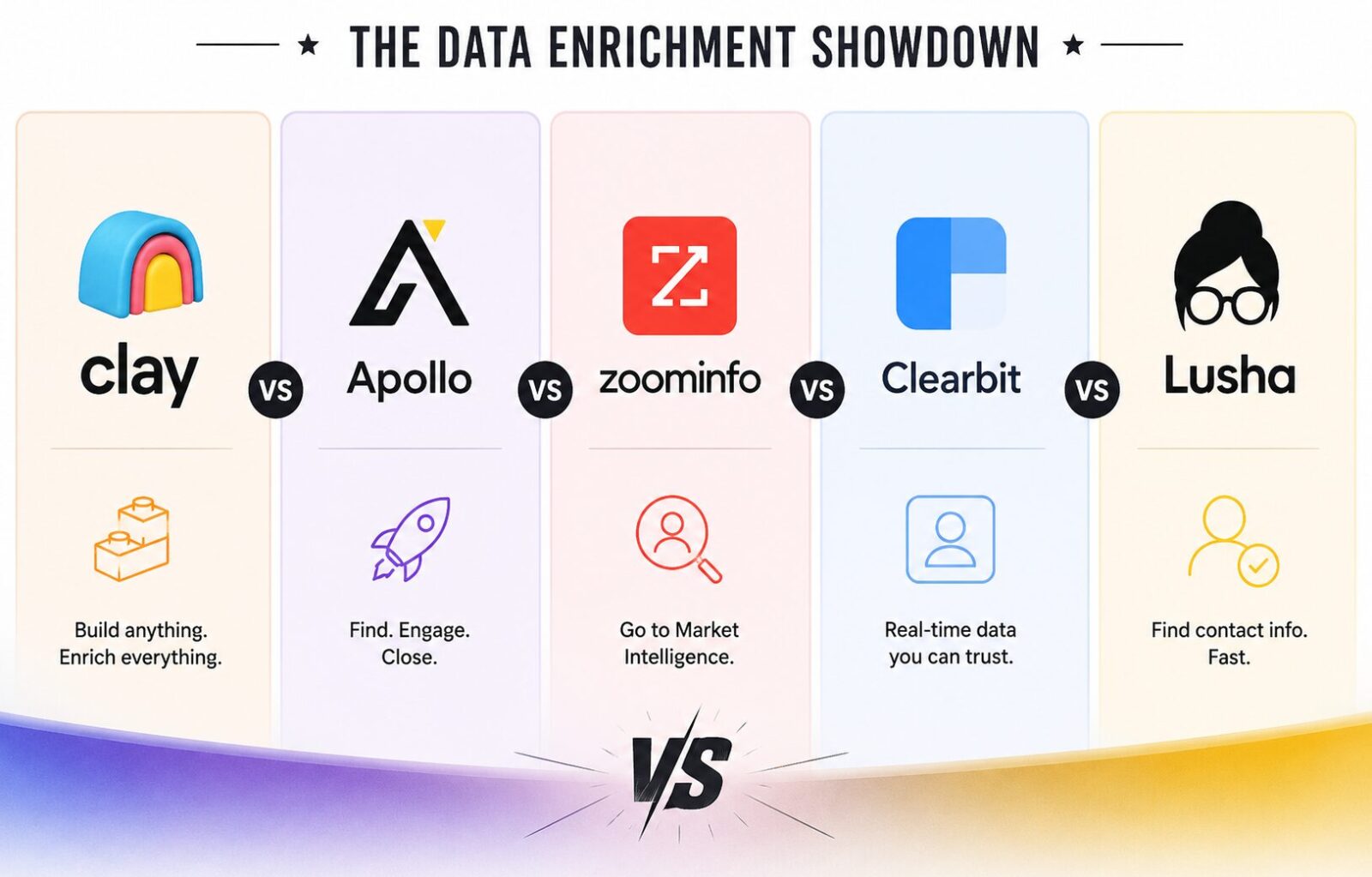
The best data enrichment tools in 2026 are no longer a single-source database you subscribe to and trust blindly. Waterfall enrichment — cascading lookups across 150+ providers — now delivers 78% email match rates versus 42% for single-source tools. The five platforms below represent every viable architecture: Clay’s multi-provider waterfall, Apollo’s all-in-one SDR stack, ZoomInfo’s enterprise database depth, Clearbit’s HubSpot-native enrichment, and Lusha’s accessible per-seat model. Each solves a different problem. Each has a different hidden cost. None of them is the right default for every team.
Updated: May 2026. All pricing reflects current plan rates. ZoomInfo pricing sourced from verified third-party sales process documentation — no public pricing page exists.
Best Data Enrichment Tools: Head-to-Head Comparison
Pull this table before reading the full breakdown.
| Factor | Clay | Apollo | ZoomInfo | Clearbit (Breeze) | Lusha |
| Entry price | $167/mo (annual) | $49/user/mo | $15,000/yr min | $45/mo + HubSpot sub | $22.45/user/mo |
| Free plan | Yes — 100 credits | Yes — limited | No | No (sunset Apr 2025) | Yes — 40 credits/mo |
| Billing model | Credits + Actions | Per-seat + credits | Annual contract | HubSpot credits | Per-seat + credits |
| Data providers | 150+ | 1 (own database) | 1 (own database) | 1 (own database) | 1 (own database) |
| Email match rate | 78% (waterfall) | ~65–70% | ~75–85% | ~75–80% | ~31–87% (varies) |
| Phone accuracy | Varies by provider | 65–70% | 75–85% | Limited standalone | 62–83% |
| CRM sync | Growth plan ($446/mo) | All paid plans | Included (add-on cost) | HubSpot only (native) | Premium ($52.45/user/mo) |
| Native email sending | No — pairs with sender | Yes — built-in sequences | Yes — Engage add-on | No | No |
| AI research agent | Claygent (advanced) | AI email writing only | Copilot (intent-focused) | Breeze AI (basic) | No |
| EMEA coverage | Depends on providers | Weaker outside US | Good (enterprise) | Limited standalone | Strong — EMEA focus |
| Setup time to value | 4–6 weeks | Same day | Weeks (enterprise) | Hours (HubSpot users) | Hours |
| Best for | RevOps, complex workflows | All-in-one SDR stack | Enterprise, large TAM | HubSpot-native teams | Solo SDRs, EMEA phone |
Note on Clearbit: HubSpot acquired Clearbit in December 2023 and rebranded it as Breeze Intelligence. All free Clearbit tools were sunset April 2025. Standard data enrichment is now free with every paid HubSpot Core Seat as of INBOUND 2025 — verify whether your HubSpot plan includes this before purchasing Breeze Intelligence add-on credits.
Why the Billing Architecture Matters More Than the Feature List
Every platform in this roundup charges credits. What differs is what burns credits, what the overage rate is, and whether credits roll over. An Apollo Basic subscriber has unlimited email credits under a fair-use policy — until they need phone numbers, at 8 credits each, with no rollover and $0.20 per overage credit. A Lusha Pro user gets 480 credits per month per seat — 480 emails, or 48 phone numbers, or any combination, and they’re gone until next billing cycle with no top-up option. A Clay Growth subscriber pays per enrichment step and per Action, with Claygent consuming variable credits depending on prompt complexity.
Map your actual monthly enrichment volume — email lookups, phone reveals, company data pulls, AI research runs — against each billing model before committing. The sticker price comparison is the wrong starting point.
1. Clay — Best for RevOps Teams Running Complex Multi-Source Workflows
What Makes Clay Different
Clay is the only platform in this roundup that aggregates 150+ data providers into a single waterfall enrichment workflow. Query Clearbit, People Data Labs, Hunter.io, Lusha, Apollo, and 145 other sources in a single table. If Provider A doesn’t return an email, Provider B fires automatically. The result: 78% email match rate on verified testing versus 42% for single-source alternatives. For B2B agencies enriching lists across multiple industries and geographies, this coverage gap is direct pipeline impact.
What changed in March 2026: Clay consolidated three self-serve plans into two. Launch ($167/mo) and Growth ($446/mo). Data marketplace costs dropped 50–90%. CRM auto-sync — previously a $800/mo Pro feature — moved down to Growth at $446/mo. The new Actions system added a secondary billing variable: every enrichment step, AI call, API request, and CRM push consumes one Action against a monthly allotment.
The Real Cost Math
Growth plan at $446/month: 6,000–50,000 data credits, 40,000 Actions/month, CRM auto-sync (Salesforce + HubSpot), HTTP API, webhooks, web intent signals. A fully enriched lead — email, phone, company data, AI research — consumes 75 credits at $0.03–$0.075/credit, putting cost per contact at $0.15–$1.12 before the platform subscription.
The 30% top-up trap: When plan credits run out, additional credits bill at a 30% markup over the plan rate. This is not published on the pricing page. Teams in the learning phase — standard for 4–6 weeks post-onboarding — consistently hit top-up pricing in months one and two. Budget plan price plus 30% for the first billing quarter.
Claygent variable cost: Clay’s AI research agent bills variably by token usage and web pages read. Simple prompts: 10–20 credits. Complex multi-page research: 50–200 credits. Individual Claygent runs documented at 5–20x basic email lookup cost. Test every prompt on a 10-row sample before scaling to full tables.
Who it’s for: RevOps leads, growth engineers, and agencies running 10,000+ enriched contacts/month who have a dedicated operator to own the build. Handing Clay to an SDR without training produces credit burn, not pipeline.
| TSA SCAR: The most common Clay failure pattern for agencies: purchasing on behalf of a client, burning the first month’s credits during configuration, hitting top-up pricing at 30% markup, and delivering a partially built workflow that the client can’t maintain. Set a credit budget cap before any client Clay deployment. Run the first workflow end-to-end internally before handing off the keys. |
2. Apollo.io — Best All-in-One SDR Stack for US-Focused Teams
The Architecture Advantage
Apollo combines a 275M+ contact database, email sequencing, a built-in dialer (Professional+), CRM sync, and AI email writing in a single subscription. For an SDR team that currently pays separately for a data tool, an email sender, and a dialer, Apollo consolidates three bills into one.
Time to value: Same day. Import a list, run a search, start a sequence. No 4–6 week ramp, no workflow configuration, no prompt engineering. Apollo is the lowest-friction path from zero to active outbound in the B2B data category.
The Real Cost Math
Plans (annual billing): Free (100 credits/mo, 2 sequences), Basic $49/user/mo (1,000 export credits), Professional $79/user/mo (2,000 export credits, dialer, AI writing), Organization $119/user/mo (4,000 export credits, call transcription, custom reports).
The phone number tax: Email credits are unlimited under fair-use on all paid plans. Phone numbers cost 8 credits each with a $0.20 overage rate and no rollover at month-end. A 3-rep team on Professional with 100 mobile credits each reveals 300 phone numbers per month maximum before overages. At 20 dials per day per rep, those 300 numbers last 5 working days. Active phone-outbound teams hit overage pricing in week one of every month.
Real cost range: Sticker price $49–$119/user/month. Active outbound teams consistently spend $150–$400/user/month once credit overages are factored in. A 10-person Professional team budgeting only the $79/user sticker price is budgeting for a $9,480/year bill. Realistic spend with phone overages: $130,000–$180,000/year.
Data quality ceiling: Apollo runs a single proprietary database. Email accuracy is 65–70%. Phone accuracy 65–70%. For niche industries, SMB markets, or non-US geographies, Apollo’s single-source coverage leaves gaps that only waterfall tools fill. Layer Clay on top for hard-to-find contacts rather than expecting Apollo to cover everything.
Who it’s for: US-focused SDR teams running email and phone outbound who want one tool instead of three. Not for EMEA-primary teams, enterprise ABM programs requiring intent data depth, or RevOps teams needing multi-source enrichment coverage.
3. ZoomInfo — Best for Enterprise Teams With $15K+ Annual Data Budgets
The Data Depth Argument
ZoomInfo holds the largest proprietary B2B database in North America: 260M+ professionals, 100M+ companies, 135M+ direct dial phone numbers. Email accuracy 75–85%. Phone accuracy 75–85%. For enterprise teams prospecting into US large-cap companies, ZoomInfo’s database depth and intent signal infrastructure (Streaming Intent from Bombora integration) represent a genuine competitive advantage that no other single platform in this roundup matches.
G2 position: #1 in 26 of 34 G2 categories it competes in. 9,000+ reviews at 4.5/5. The market’s verdict on database quality is clear for enterprise use cases.
The Pricing Reality
ZoomInfo does not publish pricing. Minimum contract: ~$14,995/year for 3 seats (Professional+ tier). Most teams pay $25,000–$60,000/year depending on seats, add-ons, and contract length. The sales process is deliberately opaque — first quotes reflect budget testing, not final pricing. Negotiation is expected and discounts are material depending on timing and leverage.
Hidden cost stack: Base platform excludes CRM enrichment ($10,000–$15,000/year add-on), extra seats beyond initial 3 ($2,000–$5,000/seat/year), and Engage (outbound sequences) as a separate module. A 10-person team with CRM enrichment and Engage can reach $50,000–$60,000/year in licensing alone.
The auto-renewal trap: ZoomInfo contracts include a 60–90 day auto-renewal window. Miss it and you’re locked in for another year at current pricing. Set a calendar reminder 90 days before contract end on the day you sign.
Who it’s for: Enterprise GTM teams with $15K+ annual data budgets, large US total addressable markets, and dedicated RevOps resources. Not for agencies billing this cost to SMB clients, teams with sub-$15K annual data budgets, or non-US-primary outbound programs.
| TSA SCAR: ZoomInfo’s credits don’t roll over. Unused credits at year-end are lost. Multiple verified users report burning credits wastefully in the final quarter to avoid losing them — a perverse incentive that produces low-quality list building. Audit your actual monthly credit consumption against your ZoomInfo allocation in month 3 of any contract. If you’re under-consuming, negotiate a credit reduction at renewal rather than wasting the allocation. |
4. Clearbit (Breeze Intelligence) — Best for HubSpot-Native Teams
What the Acquisition Changed
HubSpot acquired Clearbit in December 2023 and rebranded it as Breeze Intelligence. All free Clearbit tools — Connect, TAM Calculator, Weekly Visitor Report, free Slack integration — were sunset April 2025. The standalone Clearbit platform no longer exists. Breeze Intelligence is now a HubSpot add-on. If your CRM is not HubSpot, Clearbit does not work for you.
The INBOUND 2025 change: Standard data enrichment is now included free with every paid HubSpot Core Seat as of INBOUND 2025. Teams already on HubSpot Professional or Enterprise may not need to purchase Breeze Intelligence add-on credits for basic enrichment. Verify your current HubSpot plan’s included enrichment capability before purchasing add-ons.
The Real Cost Math
Minimum entry: $45/month for 100 Breeze Intelligence credits plus a paid HubSpot subscription starting at $20/month for Starter. Real minimum: $65–$75/month for 100 enrichment credits per month — $0.65/credit when the HubSpot base cost is factored in.
Mid-market reality: Teams on HubSpot Marketing Hub Professional ($800+/month) with moderate enrichment requirements (5,000–10,000 records/month) report total combined costs of $1,000–$5,000/month. At the high end, $64,680/year for teams with heavy AI feature usage on top of Marketing Hub Professional.
Credits expire: Breeze Intelligence credits reset every 30 days with no rollover. Unused credits are lost. This is the same pattern as ZoomInfo and Lusha — plan your monthly enrichment volume to match your credit allocation, not exceed it.
Who it’s for: Teams already operating on HubSpot as their CRM of record. For these teams, Breeze Intelligence delivers seamless, natively integrated enrichment without adding a separate vendor. For teams on Salesforce, Pipedrive, or any other CRM, evaluate Apollo or Clay instead — Clearbit’s CRM integration is HubSpot-only.
5. Lusha — Best Entry Point for Solo SDRs and EMEA-Focused Teams
Why It’s in This Roundup
Lusha is the only platform in this comparison that publishes its pricing transparently, has no minimum seat requirements on its entry plan, and specifically over-indexes on EMEA phone data. Pro at $22.45/user/month (annual) is the lowest published entry price in the B2B data enrichment category with real utility for solo SDRs and small teams.
EMEA coverage: Lusha’s community-sourced data model produces above-average accuracy for European and Israeli contacts. Independent testing confirms stronger phone data coverage in EMEA markets than Apollo or ZoomInfo for SMB and mid-market company contacts. For US-centric enterprise prospecting, ZoomInfo or Apollo outperform Lusha on both coverage and accuracy.
The Real Cost Math
Plans: Free (40 credits/mo, 1 user), Pro ($22.45/user/mo annual, 3,000 credits/year per user), Premium ($52.45/user/mo annual, 7,200 credits/year per user), Scale (custom).
The phone number tax: 1 credit = 1 email reveal. 5–10 credits = 1 phone reveal. An SDR on Pro with 250 monthly credits revealing 50% phone numbers burns through credits in 33 contacts. Phone-heavy outbound models run out of credits in the first week of each month.
Coverage gap: Independent testing of 300 mid-market B2B contacts in March 2026 returned emails for only 31% via Lusha. Strong on quality when it finds data. Weak on coverage breadth. Most teams use Lusha as a secondary tool layered with Apollo or a waterfall platform for primary coverage — not as a standalone enrichment solution.
No top-up option: When Pro credits run out mid-month, there is no way to purchase additional credits. The billing cycle resets and outbound stops. For teams with variable monthly volume, this creates unpredictable pipeline gaps.
Who it’s for: Individual SDRs testing data quality before committing to a full platform, small EMEA-focused teams needing phone data at accessible price points, and teams using Lusha as a secondary enrichment layer alongside a primary database tool.
Best Data Enrichment Tools: Real Cost Per Enriched Lead
Sticker price is the wrong comparison. This is what your team actually spends.
| Scenario | Clay (Growth) | Apollo (Professional) | ZoomInfo (entry) | Lusha (Pro) |
| Email only — 1,000 contacts | ~$50 in credits | $0 (unlimited*) | $0 (credits included) | ~$49 for 480 credits |
| Phone + email — 1,000 contacts | ~$150–375 in credits | ~$160 in overages (8 credits/phone) | Included in plan | ~$490 (5 credits/phone) |
| Full enrichment — 1,000 contacts | ~$375–750 in credits | Not available natively | Included in plan | Not available natively |
| CRM auto-sync | Included (Growth) | Included (Professional) | Add-on: $10K-$15K/yr | Premium plan only |
| Annual platform cost (3 users) | $5,352/yr (Growth) | $2,844/yr (Professional) | $15,000/yr min | $2,428/yr (Pro, 3 users) |
*Apollo email credits: Unlimited under fair-use policy. Phone credits (8 each) and export credits are capped. Real unlimited email applies to sequences, not all export scenarios.
The Agency Stack: How to Layer These Tools
No single platform in this roundup covers every enrichment scenario for a multi-client agency. The highest-performing agency enrichment stacks layer two tools: one for breadth, one for depth.
Recommended agency stack: Clay Growth ($446/month) for waterfall enrichment, AI research, and workflow automation across all client deliverables + Apollo Basic ($49/month) for the contact database and built-in email sequencing. Total stack cost: $495/month before data credits. This combination delivers waterfall coverage from 150+ providers, Claygent AI research, and Apollo’s sequences — outperforming any single-platform subscription at comparable cost for agencies enriching 5,000+ contacts/month.
When to add ZoomInfo: Enterprise client engagements where account-level intent data is required for ABM targeting. Not a default stack addition — a use-case-specific upgrade for clients with $15K+ data budgets and US enterprise ICPs.
When Clearbit fits: Agency clients already on HubSpot Professional or Enterprise. Zero additional vendor, native CRM enrichment, no credit management overhead. Check the client’s existing HubSpot plan for included enrichment before proposing Breeze Intelligence add-on spend.
Which of the Best Data Enrichment Tools Wins for Your Use Case
| Your Situation | Deploy This Tool |
| RevOps team running 10,000+ enriched contacts/month; need waterfall coverage + AI research + workflow automation | Clay Growth ($446/mo). The only tool here that combines 150+ providers, Claygent AI, and workflow orchestration in one platform. |
| SDR team needs database + email sequences + dialer in one tool, US-focused | Apollo Professional ($79/user/mo). All-in-one stack, fastest time to value, built-in sequences eliminate a separate email sender. |
| Enterprise team with $15K+ annual data budget, large US TAM, needs intent data for ABM | ZoomInfo Advanced. Best database depth and intent signals for US enterprise prospecting. Negotiate hard — first quote is not final price. |
| Already on HubSpot, need seamless CRM enrichment, no extra vendor | Clearbit (Breeze Intelligence). Zero friction for HubSpot users. Standard data enrichment now free with paid HubSpot Core Seat. |
| Solo SDR or small team (1–3 reps), EMEA-focused, need phone + email, tight budget | Lusha Pro ($22.45/user/mo annual). Best entry price in the category, strong EMEA phone data, Chrome extension for fast LinkedIn lookups. |
| Agency running multi-client enrichment workflows at scale | Clay Growth + Apollo Basic. Clay for waterfall enrichment and AI research; Apollo for the database and sequences. Two-tool stack outperforms any single platform in coverage and cost. |
| Team replacing 3–4 separate enrichment tools | Clay Growth. The waterfall architecture eliminates the need for separate vendor subscriptions. Map every tool being replaced against Clay’s credit cost before switching. |
Hidden Costs Every Agency Needs to Audit Before Signing
- Credit expiry: Apollo, ZoomInfo, Lusha, and Breeze Intelligence all expire credits monthly or annually with no rollover. Unused credits are lost revenue. Audit your actual monthly consumption against your plan allocation in month 2 of any new subscription.
- Overage markup: Clay’s top-up credits carry a 30% markup. Apollo overages: $0.20/credit. ZoomInfo overages: $0.25–$0.50/credit. Budget for overages as a fixed line item — not a contingency.
- CRM sync gating: Clay requires Growth ($446/mo) for CRM sync. Lusha requires Premium ($52.45/user/mo). Apollo includes CRM sync on Basic. Clearbit is HubSpot-only. Identify your CRM sync requirement before selecting a plan — it changes the entry price on three of these five platforms.
- ZoomInfo auto-renewal window: 60–90 days. Miss the cancellation window and you’re locked in for another year. Set the calendar reminder on contract signing day.
- Clearbit HubSpot requirement: Breeze Intelligence requires a paid HubSpot subscription. The $45/month credit price is the add-on cost, not the total cost. Factor in your HubSpot plan tier for accurate TCO.
- Lusha bulk enrichment cap: 25 contacts per batch on the Pro plan. Agencies building list enrichment workflows at volume hit this cap immediately. Premium plan removes the cap.
TSA Final Verdict
For B2B agencies building outbound stacks for multiple clients: Clay Growth + Apollo Basic. Clay’s waterfall enrichment handles every client ICP that single-source tools can’t cover. Apollo’s database provides baseline contact coverage and built-in sequences. At $495/month combined before credits, this two-tool stack outperforms any single platform for agencies enriching 5,000+ contacts/month across diverse client industries and geographies.
For in-house SDR teams needing the fastest path to live outbound: Apollo Professional ($79/user/month). Same-day setup, built-in sequences, dialer on Professional+. The all-in-one architecture eliminates tool management overhead that slows early-stage outbound programs. Audit phone credit consumption in month one — overages compound fast for phone-heavy workflows.
For enterprise teams with $15K+ annual data budgets: ZoomInfo. The database depth, intent data infrastructure, and US enterprise coverage are unmatched in the category. Negotiate the contract — first quote is a budget test. Set the auto-renewal calendar reminder on day one.
One rule across all five tools: Run your actual ICP through the free tier or trial before committing to an annual contract. Coverage rates vary dramatically by industry, company size, and geography. The platform with the highest G2 rating may return the lowest match rate for your specific target market.