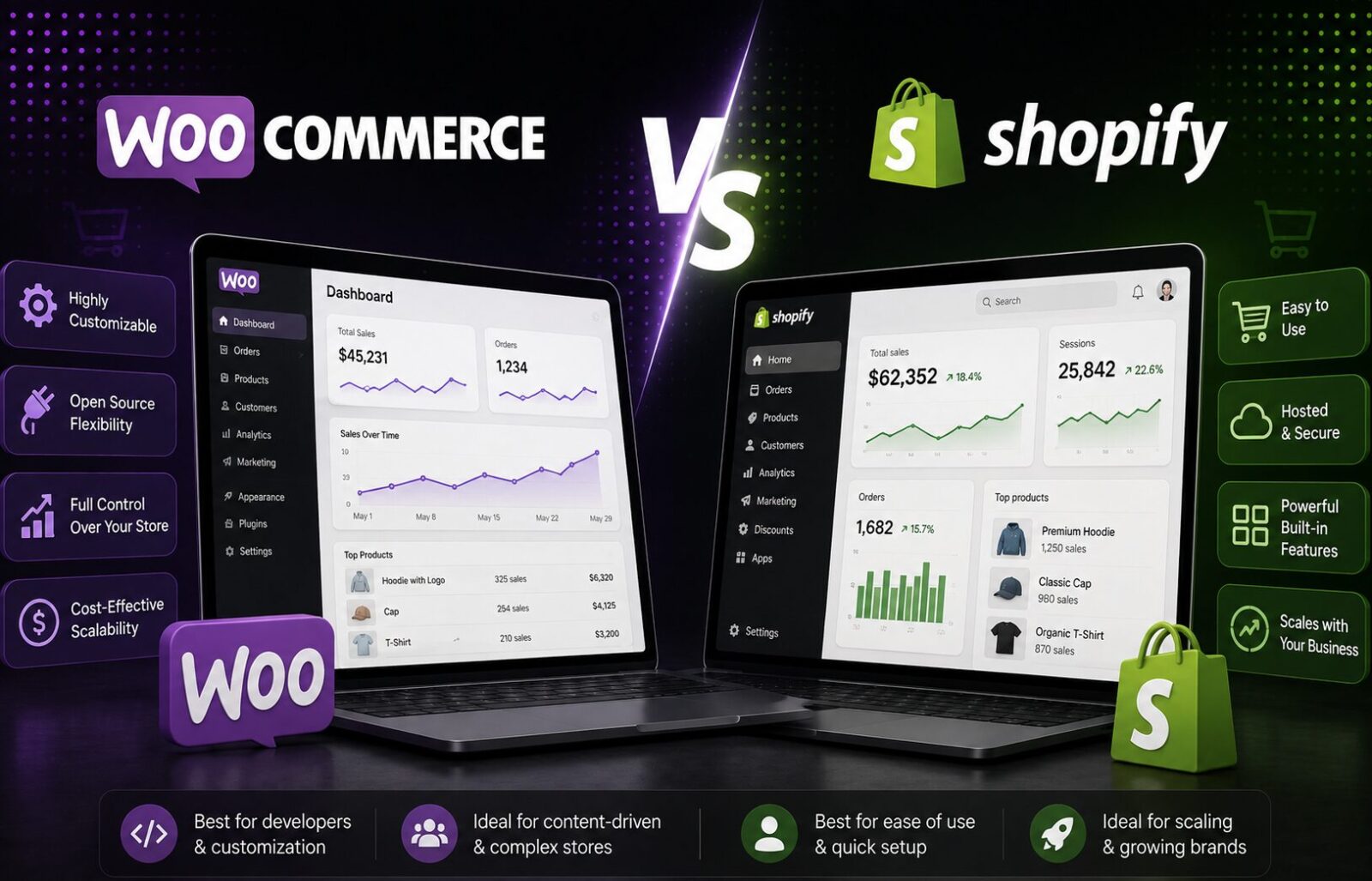
WooCommerce vs Shopify: Which Platform Wins for US Agency Clients Under $1M GMV?
Affiliate Disclosure: We review products independently. When you buy through our links, we may earn a commission or a compound recurring commission at zero extra cost to you. Read our editorial policy.
Updated: All Shopify pricing verified against on September 6, 2026. WooCommerce is open source and free. The cost scenarios in this guide combine current platform pricing with modelled assumptions for hosting, plugins, development and maintenance. Actual costs will vary by implementation and business requirements.
WooCommerce vs Shopify at a Glance
| WooCommerce | Shopify Basic | Shopify Advanced | Shopify Plus | |
|---|---|---|---|---|
| Platform cost | $0 (plugin) | $29/mo annual | $299/mo annual | $2,300/mo (3-yr) |
| Hosting required | Yes ($10 to $100/mo) | No (included) | No (included) | No (included) |
| Third-party transaction fee | $0 platform fee | 2% | 0.6% | 0.20% |
| Standard online card rate* | Depends on processor | From 2.9% + $0.30 | From 2.5% + $0.30 | From 2.25% + $0.30 *US Shopify pricing; payment-processing rates vary by plan and payment setup. |
| WordPress required | Yes | No | No | No |
| Hosting, security, PCI | Owner’s responsibility | Included | Included | Included |
| Plugin or app costs | $0 to $5,000+/yr | $0 to $5,000+/yr | $0 to $5,000+/yr | Lower (more native) |
| Shop Pay checkout benchmark | N/A | 1.72x checkout-to-order rate vs regular checkout* | 1.72x checkout-to-order rate vs regular checkout* | 1.72x checkout-to-order rate vs regular checkout* *Shopify-reported average benchmark; actual merchant results may vary. |
| SEO URL control | Full | Limited | Limited | Limited |
| B2B features | Via plugins | Yes (post-Apr 2026) | Yes (post-Apr 2026) | Yes (advanced) |
| Developer requirement | Medium to high | Low | Low | Low to medium |
TSA Verdict: WooCommerce vs Shopify for US agency clients under $1M GMV resolves on one variable: does the client have ongoing developer access or not? WooCommerce is cheaper in year one for technically self-sufficient clients and more expensive in years two and three when maintenance, plugin conflicts, and security patching overhead is correctly priced.
For US agency clients under $1M GMV, the WooCommerce vs Shopify decision depends heavily on the client’s technical resources, payment setup, customization requirements and growth strategy. WooCommerce can be highly cost-effective for technically self-sufficient businesses, while Shopify reduces much of the infrastructure and maintenance responsibility associated with running a self-hosted ecommerce stack.
For clients without in-house development support, Shopify is often the more predictable option in the scenarios modelled in this guide. For businesses with developer access, content-heavy SEO strategies or requirements for greater infrastructure control, WooCommerce can remain the stronger fit.
WooCommerce vs Shopify is the most searched platform comparison in US ecommerce for one reason: the sticker price gap is large and misleading in both directions. WooCommerce’s plugin is free. Shopify Basic is $29/month on annual billing. That $348/year versus zero comparison is what most buyers evaluate first, and it produces the wrong decision for the majority of US small business clients that US agencies serve.
WooCommerce currently powers more than 4.1 million live installations and, according to figures cited by Woo, accounts for around 30.5% of ecommerce sites. Shopify, meanwhile, reported $378 billion in GMV for 2025 and says millions of businesses across approximately 175 countries use its platform. Both platforms are mature, proven, and capable. The decision is not about capability at the under-$1M GMV level. It is about total cost of ownership, maintenance burden, checkout conversion, and SEO control, evaluated honestly against the specific client’s technical resources and growth trajectory.
Two changes in 2026 affect the WooCommerce vs Shopify comparison. Shopify made foundational B2B features available on all plans including Basic in April 2026. Previously, B2B wholesale pricing and customer accounts were Plus-exclusive. For US agency clients with basic B2B requirements under $1M GMV, this removes the platform justification for upgrading to Plus purely for B2B. Second, Shopify reports that checkouts completed through Shop Pay have an average checkout-to-order rate 1.72 times higher than regular checkouts. For US agencies where checkout conversion directly drives client ROI, this data point changes the WooCommerce vs Shopify comparison more than any feature comparison does.
This WooCommerce vs Shopify comparison is part of TSA’s broader evaluation of the best ecommerce platforms for US agency clients.
The True Cost Comparison: WooCommerce vs Shopify at Three US Revenue Scenarios
The sticker price comparison produces the wrong answer. Total cost of ownership across all four cost layers is the correct frame.
Scenario 1: US Client at $100,000 Annual GMV, No Developer on Staff
WooCommerce: Platform plugin: $0. WordPress hosting (managed, SiteGround or WP Engine entry tier): $35/month = $420/year. SSL certificate: Included with managed hosting. Premium theme: $60 one-time. Essential plugins (WooPayments, shipping, SEO, cache): $400 to $800/year. Initial setup (freelance developer): $1,500 to $3,000 one-time. Ongoing maintenance (updates, security, plugin conflicts): $500 to $1,500/year or 5 to 15 hours of owner time at no explicit cost. Payment processing (Stripe at 2.9% + $0.30, 200 transactions): $2,960/year. Year-one total: $5,340 to $6,740. Year-two ongoing: $3,780 to $5,180.
Shopify Basic: Platform (annual billing): $348/year. Theme (premium): $200 one-time. Essential apps (reviews, upsell, email): $600 to $1,200/year. Payment processing (Shopify Payments at 2.9% + $0.30, 200 transactions): $2,960/year. Year-one total: $4,108 to $4,708. Year-two ongoing: $3,908 to $4,508.
Shopify is $632 to $2,632 cheaper in year one for this client profile. In year two, the cost ranges overlap: depending on WooCommerce’s ongoing maintenance and plugin costs, either platform could be marginally cheaper.
Scenario 2: US Client at $500,000 Annual GMV, Developer Available
WooCommerce: Managed hosting (performance tier, Kinsta or WP Engine): $80/month = $960/year. Plugin stack (subscriptions, advanced shipping, B2B, SEO): $1,500 to $3,000/year. Developer maintenance: $200/month = $2,400/year. Payment processing (Stripe, 1,000 transactions): $14,750/year. Year-one total (after initial build): $19,610 to $21,110/year.
Shopify Advanced: Platform: $299/month annual = $3,588/year. App stack: $1,200 to $2,400/year. Third-party transaction fee (0.6% on $500K): $3,000/year (when applicable; avoided for transactions processed through Shopify Payments). Payment processing (Shopify Payments at 2.5% + $0.30, 1,000 transactions): $12,800/year. Year-one total (Shopify Payments): $17,588 to $18,788/year.
At $500K GMV in this model, Shopify Advanced comes out approximately $822 to $3,522 cheaper per year than WooCommerce, depending on the plugin and maintenance costs assumed. If the developer is an existing hire whose time is already allocated, however, WooCommerce may become more competitive depending on how much ongoing maintenance the store requires.
Scenario 3: US Client at $1M Annual GMV
At this level, the platform decision increasingly depends on operational complexity rather than GMV alone. Shopify Advanced may remain sufficient for some businesses, while others may begin evaluating Shopify Plus for requirements such as more advanced B2B functionality, checkout customization or larger organizational needs.
Shopify Plus currently starts at $2,300 per month on a three-year term. WooCommerce does not have an equivalent fixed platform subscription, so its total cost will depend on hosting, extensions, development, maintenance and the complexity of the implementation.
TSA Recommendation: Do not use GMV alone as the trigger for moving to Shopify Plus. Compare the operational requirements of the business with the capabilities and total cost of Shopify Advanced, Shopify Plus and the existing WooCommerce stack.
For clients approaching $1M GMV where Shopify Plus becomes the relevant evaluation, see the Shopify Plus pricing breakdown.
The Shop Pay Conversion Advantage: The Data Most WooCommerce vs Shopify Reviews Skip
This is the most important number in the WooCommerce vs Shopify comparison for US agencies managing client stores where checkout conversion drives the business case.
Shopify reports that checkouts completed through Shop Pay have an average checkout-to-order rate 1.72 times higher than regular checkouts. This is an important distinction: the benchmark relates specifically to checkout completion, not a store’s overall visitor-to-purchase conversion rate.
For agencies evaluating Shopify for conversion-focused clients, the data supports the potential value of reducing friction at checkout. However, the 1.72x benchmark should not be applied directly to a store’s overall conversion rate or used to project a guaranteed revenue increase. Actual results will depend on factors such as traffic quality, customer mix, device usage and Shop Pay adoption.
TSA Recommendation: Treat Shop Pay’s 1.72x figure as a checkout-performance benchmark and evaluate its actual revenue impact using the client’s own checkout and conversion data.
Shop Pay remains a significant strength of Shopify’s checkout ecosystem because it is integrated directly into the Shopify experience. However, Shop Pay is no longer limited to stores built on Shopify. Eligible merchants on other commerce platforms can integrate Shop Pay without migrating their store, although doing so requires Shopify Payments eligibility and API integration.
The advantage for Shopify merchants is therefore less about exclusive access to Shop Pay and more about having the accelerated checkout experience integrated natively into the broader Shopify platform.
For agencies presenting the WooCommerce vs Shopify business case to a client focused heavily on conversion-rate optimization, checkout performance can therefore be an important part of the evaluation alongside platform cost, flexibility and maintenance requirements.
Where WooCommerce Wins the WooCommerce vs Shopify Comparison
Zero platform transaction fees.
WooCommerce charges no platform transaction fee. Payment processor fees (Stripe, PayPal, Square) are the only fee on every transaction. Shopify currently charges an additional third-party transaction fee of 2% on Basic, 1% on Grow, 0.6% on Advanced and 0.2% on Plus when applicable third-party payment providers are used.
At $500K annual GMV processed through an applicable third-party payment provider on Shopify Advanced, a 0.6% Shopify transaction fee would equal $3,000/year, in addition to the payment provider’s own processing charges. WooCommerce at the same volume: $0 platform surcharge. For US clients committed to specific payment gateways outside Shopify’s zero-fee list, this surcharge is a recurring annual cost that WooCommerce eliminates entirely.
Full SEO control.
WooCommerce on WordPress gives agencies complete control over URL structure, canonical tags, structured data, faceted navigation configuration, and technical SEO architecture. A US agency managing a client store where organic search is the primary revenue channel generally has greater control over technical SEO implementation in a self-hosted WordPress/WooCommerce environment.
Shopify’s URL structure enforces /products/, /collections/, and /pages/ path structures. Redirecting away from these requires workarounds. Faceted navigation SEO (handling pagination, filter combinations, and parameter URLs) requires careful configuration in Shopify that WooCommerce handles more flexibly. For SEO-first US agencies, the technical SEO flexibility of WooCommerce on WordPress is a genuine operational advantage.
Content marketing integration.
WordPress is one of the world’s most widely used content management platforms, and WooCommerce allows ecommerce and editorial content to operate within the same WordPress environment. WooCommerce on WordPress means the store and the blog share the same CMS, the same URL domain, the same internal linking structure, and the same analytics setup. US agencies running content-driven ecommerce strategies where SEO blog posts drive product discovery benefit from this unified architecture in ways that Shopify’s separate blog environment does not match.
Full data ownership.
WooCommerce stores live on infrastructure the client controls. Customer data, order history, product data, and all store assets are on a server the client owns or controls. Shopify stores live on Shopify’s infrastructure. While data is exportable from Shopify, the live store data is on Shopify’s servers under Shopify’s terms of service. For US clients in regulated industries or with specific data sovereignty requirements, WooCommerce’s self-hosted model provides ownership clarity that Shopify does not.
Where Shopify Wins the WooCommerce vs Shopify Comparison
Maintenance-free infrastructure.
Hosting, SSL, CDN, PCI compliance, security patches, and WordPress core updates are all Shopify’s responsibility. A US agency client on Shopify does not receive a midnight email about a WordPress security vulnerability requiring immediate patching. WooCommerce clients do. The hidden cost of WooCommerce is the maintenance burden that compounds with every additional plugin and every WordPress core update.
TSA SCAR: Budget for Plugin Compatibility and Maintenance
WooCommerce’s extensibility is one of its major strengths, but stores that depend on multiple plugins also introduce more components that need to remain compatible with WordPress, WooCommerce, themes and other extensions.
WooCommerce recommends testing updates to WooCommerce, extensions, payment gateways and themes in a staging environment before deploying them to a live store.
This does not mean plugin conflicts will occur on every WooCommerce store. The operational risk depends on the extensions being used, custom code, update practices and the complexity of the overall stack.
TSA Recommendation: Agencies managing WooCommerce stores should include staging, update testing and compatibility troubleshooting in the ongoing maintenance plan rather than budgeting only for hosting and plugin subscriptions.
App and Extension Ecosystems
Both platforms have extensive ecosystems for extending store functionality. Shopify operates a centralized App Store with thousands of apps covering areas such as subscriptions, reviews, marketing, fulfillment and store management, and apps are reviewed before being listed.
WooCommerce stores can draw from the official Woo Marketplace, WordPress.org and independent extension developers. Woo applies review requirements to products submitted to its own marketplace, although quality and maintenance standards can vary across the wider WordPress plugin ecosystem.
For agencies, the relevant consideration is therefore not simply the number of available apps or plugins, but the quality, compatibility, support and ongoing cost of the extensions required for a specific store.
Speed to launch
A relatively straightforward Shopify implementation can require less technical setup than an equivalent self-hosted WooCommerce build because hosting, SSL and much of the underlying commerce infrastructure are already managed within the platform.
Actual implementation time for either platform will depend on catalog size, theme customization, integrations, data migration, payment configuration and testing requirements.
TSA Recommendation: Estimate launch time against the scope of the individual project rather than treating a fixed number of weeks as a platform-wide benchmark.
The Agency Recommendation Framework: WooCommerce vs Shopify
US agencies use this framework before making a platform recommendation to any client under $1M GMV.
Recommend Shopify when:
The client has no in-house developer and no budget for ongoing development maintenance.
Checkout conversion is the primary growth lever and the client’s traffic volume makes the Shop Pay conversion differential material.
The client needs to launch in under 4 weeks.
The client’s primary sales channel is direct-to-consumer with standard product types and standard checkout.
The client has previously struggled with website maintenance, security, or performance issues on self-hosted platforms.
Recommend WooCommerce when:
The client already runs a WordPress website and WooCommerce adds ecommerce capability to an existing content platform without a separate domain or CMS.
The client has an in-house developer or an ongoing development retainer with the agency that absorbs the WooCommerce maintenance overhead.
Full SEO control and content-driven organic growth is the primary revenue strategy.
The client processes payments through a non-Shopify gateway at high volume where Shopify’s surcharge creates a meaningful annual cost.
The client has data sovereignty requirements that prevent hosting customer data on third-party SaaS infrastructure.
Above $1M GMV, the WooCommerce vs Shopify comparison expands to include enterprise platform alternatives covered in the Shopify Plus alternatives guide
Buy / Skip Decision Matrix: WooCommerce vs Shopify
| Scenario | Verdict |
|---|---|
| US client without developer, needs store live in under 4 weeks | Shopify Basic ($29/mo annual) |
| US client where checkout conversion is primary growth KPI | Shopify for Shop Pay. 1.72x conversion benchmark is the deciding factor. |
| US client processing $500K GMV through an applicable third-party provider on Shopify Advanced | Model Shopify Payments migration. A 0.6% Shopify transaction fee represents $3,000/year at this GMV before considering differences in payment-processing rates. |
| US client already on WordPress with active blog driving organic traffic | WooCommerce. Unified CMS and SEO architecture wins on content-driven commerce. |
| US client with in-house developer and SEO-first growth strategy | WooCommerce. Developer absorbs maintenance overhead, SEO control is preserved. |
| US client in regulated industry requiring data sovereignty | WooCommerce on self-hosted infrastructure. |
| US agency quoting WooCommerce management without plugin conflict budget | Include ongoing maintenance, staging, update testing and compatibility troubleshooting in the cost model. |
| US client approaching $1M GMV on WooCommerce | Re-evaluate platform requirements and TCO; compare the existing WooCommerce stack with Shopify Advanced and, where advanced requirements justify it, Shopify Plus. |
| B2B wholesale features needed under $1M GMV | Shopify Basic or Advanced post-April 2026. B2B features no longer exclusive to Plus. |
FAQ
Is WooCommerce or Shopify better for a US small business in 2026?
For US small businesses without developer access, Shopify wins on total cost of ownership when maintenance overhead is correctly priced. Shopify Basic at $29/month annual includes hosting, security, PCI compliance, and a checkout that converts at 1.72x the rate of standard checkout through Shop Pay. WooCommerce’s zero plugin cost is offset by hosting ($35 to $80/month), plugin subscriptions ($400 to $3,000/year), and developer maintenance ($500 to $2,400/year). For businesses with developer access running content-first SEO strategies on WordPress, WooCommerce is the stronger architectural fit.
What is the real cost of WooCommerce vs Shopify for a $100,000 GMV US store?
In the model used in this guide, a $100,000-GMV store without an in-house developer comes to approximately $5,340–$6,740 in year one for WooCommerce versus $4,108–$4,708 for Shopify Basic, including the assumptions listed above. That makes Shopify approximately $632–$2,632 cheaper in year one in this particular scenario. Actual costs will vary based on hosting, apps/plugins, development requirements and payment setup.
Does Shopify charge transaction fees in 2026?
Shopify charges an additional platform fee for transactions processed through third-party gateways not using Shopify Payments: 2% on Basic, 1% on Grow, 0.6% on Advanced and 0.2% on Plus. Using Shopify Payments eliminates these surcharges entirely. WooCommerce charges zero platform transaction fees regardless of payment gateway. At $500K annual GMV processed through an applicable third-party provider on Shopify Advanced, the 0.6% Shopify transaction fee would equal $3,000/year, in addition to the provider’s processing fees.
What changed in Shopify in 2026 that affects the WooCommerce vs Shopify decision?
April 2026: Shopify made foundational B2B features available on all plans including Basic. Foundational B2B capabilities including company profiles, payment terms, volume pricing and up to three active B2B catalogs are now available on Basic, Grow and Advanced. More advanced capabilities, including unlimited catalogs and direct catalog assignment to individual companies and locations, remain Plus features.
How does Shop Pay affect the WooCommerce vs Shopify conversion comparison?
Shopify reports that Shop Pay checkouts have an average checkout-to-order rate 1.72 times higher than regular checkouts. This benchmark applies to checkout completion rather than a store’s overall visitor-to-purchase conversion rate.
For US clients where checkout abandonment is a significant issue, Shop Pay can therefore be an important consideration. However, agencies should use the client’s own checkout data to estimate the potential financial impact rather than applying the 1.72x benchmark directly to total site conversion or revenue.
When should a US agency recommend WooCommerce over Shopify?
Three specific scenarios justify WooCommerce over Shopify for US agency clients. First, when the client already runs a WordPress website with active content marketing and WooCommerce extends that existing investment without a separate platform. Second, when the client has an in-house developer or an ongoing agency development retainer that absorbs WooCommerce’s maintenance overhead, eliminating the cost disadvantage. Third, when the client processes high volume through a specific payment gateway outside Shopify’s zero-fee list and the annual platform surcharge savings on WooCommerce exceed the maintenance cost differential.