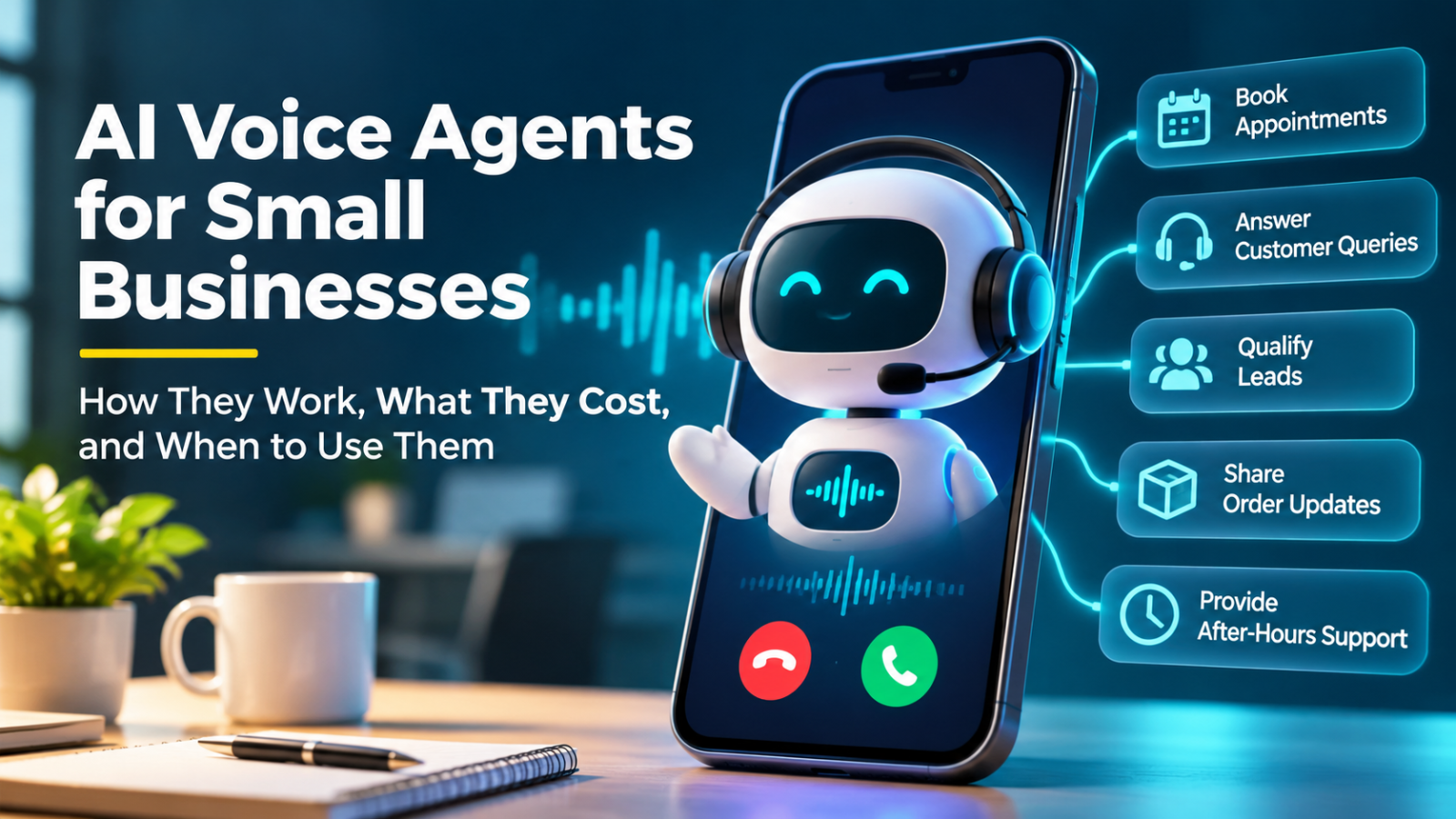
AI Voice Agents for Small Businesses: How They Work, What They Cost, and When to Use Them
Affiliate Disclosure: We review products independently. When you buy through our links, we may earn a commission or a compound recurring commission at zero extra cost to you. Read our editorial policy.
AI voice agents are changing how small businesses handle phone calls. From answering routine customer questions to booking appointments and qualifying leads, these systems can manage conversations without requiring a human employee to answer every call.
For a small business, the appeal is straightforward: fewer missed calls, faster responses, and more time for employees to focus on work that requires human judgment.
But AI voice agents are not a universal replacement for receptionists, sales representatives, or customer support teams. Their usefulness depends on the type of calls a business receives, the complexity of its services, and how well the technology connects with existing systems.
This guide explains how AI voice agents work, where small businesses can use them, what they cost, and what to consider before deploying one.
What Are AI Voice Agents?
An AI voice agent is a software system that can understand spoken language, respond conversationally, and perform specific tasks during a phone or voice-based interaction.
Unlike traditional automated phone systems that ask callers to press numbers, an AI voice agent can interpret questions and respond based on the context of a conversation.
For example, a customer calling a dental clinic might say:
“I’d like to book an appointment for Friday afternoon.”
The voice agent can understand the request, check available appointment slots through an integrated scheduling system, and guide the caller through the booking process.
Depending on its configuration, it may also answer questions about opening hours, services, pricing, location, and appointment policies.
AI voice agents are sometimes called AI phone agents, conversational voice agents, or voice AI assistants. Although the terms are often used interchangeably, the underlying capabilities can vary significantly between platforms.
How Do AI Voice Agents Work?
Most AI voice agents combine three core technologies:
1. Speech-to-Text (STT)
The system converts a caller’s spoken words into text that an AI model can process. This allows it to identify what the caller is asking and extract relevant information.
2. Large Language Models (LLMs)
The language model interprets the request, considers the conversation’s context, and determines an appropriate response or action. It can also use information supplied through a business knowledge base or connected applications.
3. Text-to-Speech (TTS)
The response is converted into spoken audio. The quality of this technology influences how natural, clear, and understandable the conversation sounds.
These components work together in a conversational loop:
Caller speaks → Speech is interpreted → AI processes the request → Response is generated → Voice is played to the caller.
A more advanced voice agent can also connect to external systems, allowing it to do more than answer questions.
For example, it might:
- Check appointment availability.
- Create or update a customer record.
- Send a confirmation message.
- Transfer a call to a human employee.
- Retrieve information from a CRM or business database.
The important distinction is that a voice agent becomes operationally useful when it can access the information and systems required to complete a task.
AI Voice Agents vs. Traditional IVR vs. Chatbots
These technologies all help businesses handle customer interactions, but they serve different purposes.
| Feature | Traditional IVR | Text Chatbot | AI Voice Agent |
|---|---|---|---|
| Interaction | Keypad or fixed menus | Typed messages | Spoken conversation |
| Natural language | Limited | Usually supported | Usually supported |
| Handles phone calls | Yes | Not typically | Yes |
| Understands context | Limited | Varies | Varies |
| Can integrate with business systems | Yes | Yes | Yes |
| Best suited for | Call routing | Website and messaging support | Conversational phone support |
Traditional IVR systems are useful for predictable call-routing requirements. Chatbots are convenient when customers prefer messaging. AI voice agents are more suitable when callers want to speak naturally and complete tasks over the phone.
The right choice depends on customer preferences, call volume, and the complexity of the interaction.
Where Can Small Businesses Use AI Voice Agents?
AI voice agents are particularly useful for businesses that receive repetitive enquiries, appointment requests, and routine customer calls.
Here are seven practical applications.
1. Appointment Booking and Scheduling
Clinics, salons, consultants, repair services, and other appointment-based businesses can use voice agents to handle routine booking requests.
A customer can ask for an available appointment, provide a preferred date, and receive confirmation once the system checks the connected calendar.
The agent may also handle rescheduling and cancellations, provided the scheduling platform supports those actions.
2. Lead Qualification
Businesses that receive enquiries from potential customers can use voice agents to collect basic information before passing a lead to a sales representative.
For example, a real estate business could configure its agent to ask callers about:
- Preferred property location.
- Budget range.
- Property type.
- Expected purchase timeline.
The collected information can then be added to a CRM or forwarded to the relevant salesperson.
This allows the sales team to prioritise enquiries instead of spending time gathering the same preliminary information repeatedly.
3. Customer Support
An AI voice agent can answer frequently asked questions about business hours, service availability, order status, return procedures, and basic troubleshooting.
It can also direct callers to the appropriate department when a request falls outside its capabilities.
For complex complaints, sensitive conversations, or situations requiring discretion, a human support representative should remain available.
4. After-Hours Call Handling
Small businesses cannot always maintain round-the-clock phone support.
A voice agent can answer calls outside business hours, collect caller details, explain when the business will reopen, and record the reason for the enquiry.
This can help businesses capture opportunities that might otherwise be lost to unanswered calls.
5. Order and Service Updates
Businesses that handle regular orders, deliveries, or service appointments may use voice agents to respond to routine status enquiries.
With appropriate system access, the agent can retrieve relevant information and communicate updates without requiring an employee to check each request manually.
6. Service Enquiry Management
Home service providers, repair companies, and maintenance businesses often receive calls describing similar problems.
A voice agent can collect the customer’s name, location, service requirement, and preferred appointment window before routing the enquiry to the appropriate team.
It should not make unsupported technical diagnoses or promise a service outcome that the business has not confirmed.
7. Call Routing and Message Collection
Not every call needs to be resolved by AI.
A voice agent can identify the caller’s requirement and transfer the conversation to the appropriate employee or department. If nobody is available, it can collect a message and arrange a callback.
This is often a sensible starting point for businesses that want to improve call handling without automating the entire customer experience.
What Makes an AI Voice Agent Useful Beyond Answering Calls?
Answering a phone call is only the first step. The real operational benefit comes when the agent can complete a task using information from the business’s existing software.
Consider a small marketing agency receiving a call from a prospective client.
The agent could:
- Ask about the caller’s business and service requirements.
- Collect their contact details.
- Identify the type of service they are interested in.
- Check the availability of a consultation slot.
- Create a lead record in the CRM.
- Send a confirmation message.
This requires integrations with systems such as calendars, CRMs, messaging services, and workflow automation platforms.
Businesses exploring these connections may also find our guides on Make.com vs. n8n and n8n Cloud vs. Self-Hosted useful.
Automation can connect the voice agent to other applications, but it also introduces additional considerations around permissions, reliability, and data handling.
For a broader look at the risks, read our guide to AI Automation Security in 2026.
AI Voice Agent Platforms: An Example Using ElevenLabs
Several platforms offer tools for building conversational AI voice agents. One example is ElevenLabs, which offers voice technology and a dedicated conversational AI product called ElevenAgents.
ElevenAgents provides tools for building voice agents with features such as:
- Conversational voice interactions.
- Knowledge bases.
- Workflow building.
- Multilingual capabilities.
- Call handling and concurrency controls.
- Integrations with external language models and telephony providers.
The platform can be used to create agents for customer support, appointment handling, lead qualification, and other conversational workflows.
However, businesses should distinguish between a voice-generation tool and a complete voice-agent deployment. Generating realistic speech alone does not provide the scheduling, CRM access, call routing, or business logic required to run an operational phone service.
Before choosing a platform, evaluate its integrations, call-handling capabilities, supported languages, data controls, and total operating cost.
How Much Do AI Voice Agents Cost?
Pricing varies by platform and depends on factors such as included call minutes, additional usage, concurrent calls, language-model consumption, and telephony.
To illustrate the cost structure, the following table uses ElevenLabs’ published ElevenAgents monthly pricing.
ElevenAgents Pricing
| Plan | Monthly Price | Included Call Minutes | Concurrent Calls |
|---|---|---|---|
| Free | $0 | 15 | 4 |
| Starter | $6 | 75 | 6 |
| Creator | $22 | 275 | 10 |
| Pro | $99 | 1,238 | 20 |
| Scale | $299 | 3,738 | 30 |
| Business | $990 | 12,375 | 40 |
| Enterprise | Custom | Custom | Custom |
Pricing checked on November 19, 2026. Prices are in USD, exclude applicable taxes, and may change. Promotional first-month offers are excluded.
According to the platform’s published pricing information, additional call minutes are charged at $0.08 per minute. Burst usage above the concurrency limit can be charged at a higher rate. Text messages are priced separately, and external language-model usage may also add to the bill.
If a business connects an external telephony provider, that provider may charge separately for its services.
The practical cost therefore depends on more than the monthly subscription.
What Should Businesses Include in Their Cost Calculation?
Before selecting a plan, estimate:
- Expected calls per month.
- Average duration of each call.
- Total monthly call minutes.
- Number of calls that may happen simultaneously.
- Additional usage charges.
- Language-model and telephony costs, where applicable.
- Costs of integrations or third-party automation tools.
For example, a business receiving 100 calls per month with an average duration of three minutes would use approximately 300 call minutes.
A plan that includes 75 minutes would not cover that usage. The business would need to consider a higher plan or calculate the additional usage charges.
It is also important to test actual call duration. A conversation involving clarification, transfers, or follow-up questions may last longer than expected.
The takeaway: Do not select a plan based only on its starting price. Estimate actual usage and compare the total cost of running the agent.
What Are the Limitations of AI Voice Agents?
Despite their potential, AI voice agents have limitations that businesses should understand before deployment.
1. They Can Misunderstand Callers
Background noise, accents, poor network quality, interruptions, and unclear speech can affect recognition accuracy.
A system that misunderstands a caller’s request may provide an irrelevant response or initiate the wrong action.
2. They May Generate Incorrect Answers
An AI model can produce a confident-sounding answer that is inaccurate or unsupported.
Businesses should restrict the agent to approved information and configure clear rules for situations it cannot handle.
3. Complex Conversations Still Need Humans
Customer disputes, sensitive complaints, unusual requests, and high-value sales conversations often require judgment and empathy.
A reliable deployment should provide a clear route to a human employee.
4. Integrations Can Fail
A voice agent may depend on external calendars, CRMs, APIs, or automation workflows.
If one of these systems is unavailable, the agent may be unable to complete the requested task. Businesses should define what happens when an integration fails and avoid telling customers that an action has been completed until it is confirmed.
5. Privacy and Data Security Need Attention
Voice interactions may involve names, phone numbers, addresses, payment-related information, or other personal data.
Businesses should understand what information is recorded, where it is stored, how long it is retained, who can access it, and whether it is used for model training.
For businesses connecting multiple AI tools and applications, our article on AI Automation Security in 2026 provides additional context.
Privacy and Compliance: What Should US Businesses Know?
Businesses using AI voice agents should consider privacy, consent, call-recording rules, and telemarketing requirements before going live.
In the United States, the Federal Communications Commission (FCC) clarified in February 2024 that AI-generated voices fall within the Telephone Consumer Protection Act’s restrictions on artificial or prerecorded voice calls.
For covered outbound calls, the rules can require prior express consent, subject to applicable exceptions. Additional identification, disclosure, and opt-out requirements may apply, particularly to calls involving advertising or telemarketing.
Businesses should not assume that an AI-generated voice is exempt from existing robocall rules simply because it can respond conversationally.
Other considerations include:
- Applicable federal and state call-recording and consent laws.
- Privacy policies and customer disclosures.
- Secure handling of call transcripts and recordings.
- Restrictions on using customer data.
- Clear escalation procedures for sensitive interactions.
The FCC’s Declaratory Ruling on AI-generated voices and the TCPA is an important starting point for understanding the federal requirements. Businesses should obtain appropriate legal advice for their specific calling activities and jurisdictions.
How to Get Started With an AI Voice Agent
A small business does not need to automate every phone interaction at once. A limited pilot is usually a more practical way to evaluate the technology.
Step 1: Identify a Repetitive Call Type
Start with a clearly defined task, such as answering opening-hour enquiries, collecting service requests, or scheduling appointments.
Avoid beginning with complex sales negotiations or sensitive customer complaints.
Step 2: Prepare an Approved Knowledge Base
Give the agent accurate information about the business, including services, opening hours, policies, locations, and frequently asked questions.
Keep the information updated. Outdated pricing or incorrect service details can damage customer trust.
Step 3: Choose a Platform
Compare platforms based on voice quality, response speed, supported languages, integrations, call capacity, data controls, and pricing.
A platform should be evaluated on its ability to complete the intended business task, not simply on how natural its voice sounds.
Step 4: Connect the Required Systems
Integrate the agent with the tools it needs, such as a calendar, CRM, helpdesk, or booking application.
Workflow automation platforms can help connect systems that do not have a direct integration. Businesses considering this approach can explore our guide on migrating from Zapier to n8n.
Step 5: Define Escalation Rules
Decide when the agent should transfer a call, collect a message, or stop and ask for human assistance.
These rules are important for preventing the system from attempting to handle situations beyond its capabilities.
Step 6: Test Before Launch
Run test calls using different accents, speaking speeds, background noise levels, and customer requests.
Check whether the agent understands questions correctly, retrieves accurate information, completes integrations, and transfers calls when required.
Step 7: Monitor Performance
After launch, review:
- Number of calls handled.
- Average call duration.
- Successful task-completion rate.
- Call transfers and escalation frequency.
- Customer feedback.
- Incorrect or incomplete responses.
- Total cost per completed interaction.
Use these findings to improve the agent’s instructions, knowledge base, and workflows.
Are AI Voice Agents Worth It for Small Businesses?
AI voice agents can be valuable when a business receives a regular volume of repetitive calls and has clearly defined processes for handling them.
They are particularly relevant to appointment-based businesses, service providers, agencies, clinics, and businesses that need to capture enquiries outside normal working hours.
However, they may not be worthwhile for a business that receives very few calls or depends heavily on personal conversations and complex customer interactions.
A useful way to evaluate the investment is to compare the cost of the voice agent with the time spent handling calls manually, the value of enquiries that might otherwise be missed, and the quality of the resulting customer experience.
The objective should not be to automate phone calls simply because the technology is available. It should be to improve a specific business process without making customer interactions more complicated.
Frequently Asked Questions
1. What is the difference between an AI voice agent and an AI chatbot?
An AI chatbot generally interacts through text, while an AI voice agent communicates through spoken conversations. Both can use language models and connect to business systems, but voice agents are designed specifically for audio-based interactions.
2. Can an AI voice agent answer phone calls 24/7?
Many platforms support automated call handling beyond normal business hours. However, availability depends on the platform, subscription, telephony setup, and system configuration.
3. Can AI voice agents book appointments?
Yes. An agent can book, reschedule, or cancel appointments when it is connected to a compatible scheduling system and has the appropriate permissions.
4. Can AI voice agents integrate with a CRM?
Many platforms support CRM integrations directly or through APIs and workflow automation tools. The available capabilities vary, so businesses should verify whether the agent can create, update, and retrieve the records they need.
5. Are AI voice agents expensive?
Costs vary considerably. Some platforms offer free or low-cost entry plans, while higher-volume deployments can involve subscription fees, additional call minutes, language-model usage, and telephony charges.
6. Can AI voice agents replace human customer support employees?
They can handle certain repetitive enquiries and routine tasks, but they should not be treated as a complete replacement for human support. Complex complaints, sensitive conversations, and situations requiring judgment still need human involvement.
7. Are AI voice agents legal in the United States?
Their use is subject to applicable laws and regulations. In particular, AI-generated voices used in covered outbound calls fall under the FCC’s interpretation of artificial or prerecorded voice restrictions in the TCPA. Consent and other requirements may apply depending on the nature of the call.
8. Which businesses should consider using AI voice agents?
Appointment-based businesses, clinics, salons, real estate companies, agencies, repair services, and customer support teams may benefit when they receive recurring calls that follow predictable processes.
Final Thoughts
AI voice agents are becoming a practical option for small businesses looking to improve how they manage phone interactions. They can answer routine questions, capture leads, schedule appointments, and connect customer conversations with existing business systems.
But the technology is only as useful as the processes behind it. Businesses need accurate information, reliable integrations, clear escalation rules, and a realistic understanding of usage costs.
For most small businesses, the best starting point is a narrowly defined use case. Test it, measure the results, and expand only when the agent demonstrates that it can improve the customer experience and reduce repetitive work.